


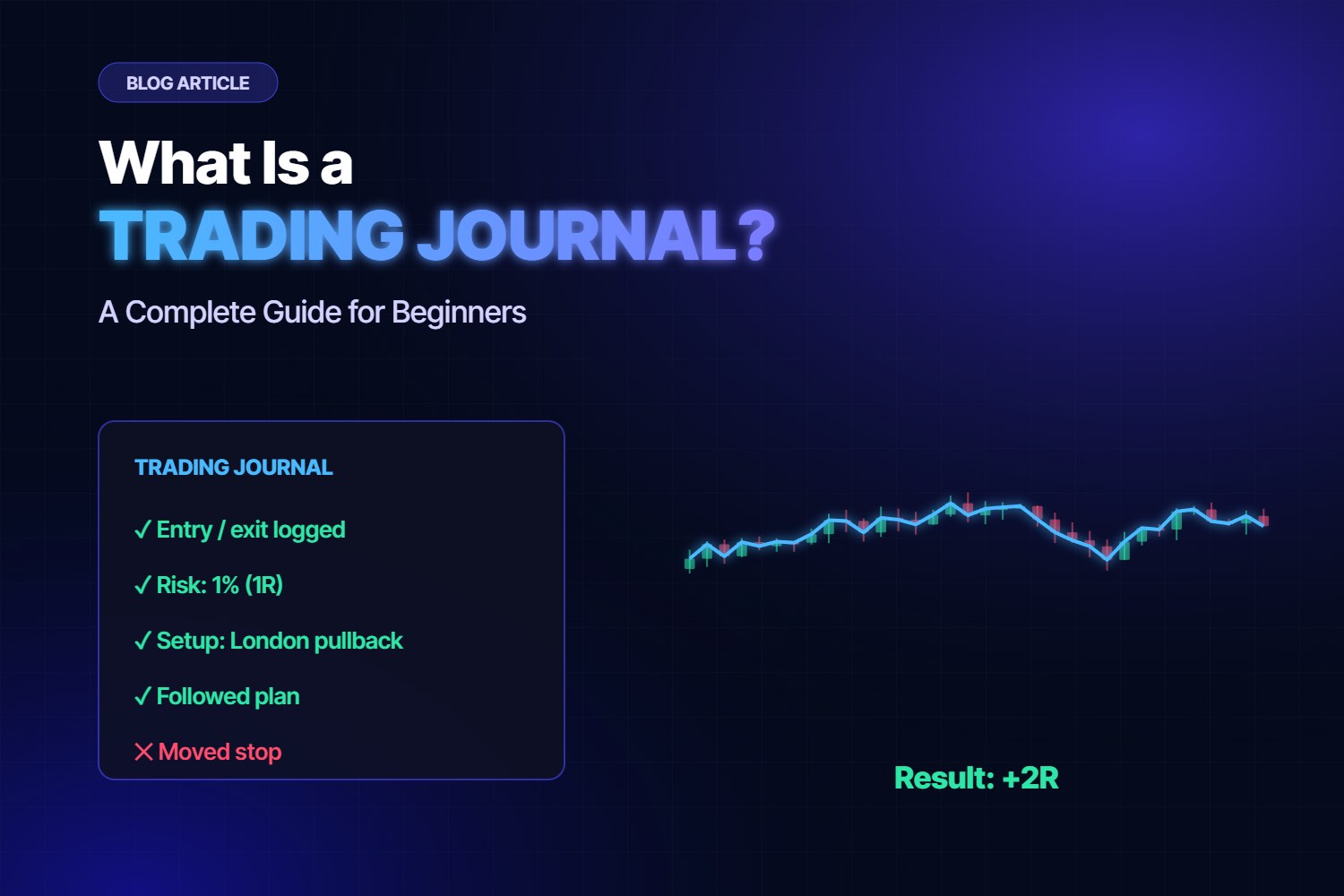
Futures Trading Journal: What to Track for ES, NQ and Micro Futures
Futures traders face problems a generic journal does not handle well: results measured in ticks and points, commissions that eat into small scalps, partial fills, and prop firm rules built around trailing drawdown. A good futures trading journal turns all of that into clear numbers.
What makes futures journaling different
- Contract math. Each contract has its own tick size and tick value. One ES point is worth $50, one MES point $5, one NQ point $20 and one MNQ point $2.
- Commissions per round turn. On a two-tick scalp, fees can be a large share of the result.
- Scaling and partial fills. Fills must be grouped into complete trades or your statistics will be wrong.
- Trailing drawdown. Many futures evaluations use a drawdown that follows your highest balance.
What to record
- Contract, direction, contracts traded, entry and exit
- Result in ticks, points, dollars and R
- Commissions and net P&L
- Setup and time of day (open, mid-morning, lunch, afternoon, close)
- Rule compliance and emotional state
The metrics that matter most
- Net expectancy after commissions: your average result per trade once fees are included. Try the expectancy calculator.
- Profit factor: see profit factor explained
- Average win vs. average loss in ticks
- Performance by time of day: many traders find most of their edge in the first hour
- Distance to trailing drawdown on funded accounts
A simple weekly review
- Compare gross and net P&L to see what commissions cost you.
- Rank your setups by net expectancy and cut the weakest.
- Check your results by time of day and avoid the hours that lose.
- Review the day you came closest to your drawdown limit and write one rule to prevent it.
Automate it
Clarity Tracking syncs futures trades from Tradovate, NinjaTrader and Volumetrica, groups fills into trades, and shows results in ticks, points and dollars with commissions included. Use the free position size calculator to size contracts and the prop firm challenge calculator to plan evaluations.
FAQ
Should I journal micros and minis separately?
Yes. Tag or filter by contract so you can see whether your edge holds as size increases.
How many trades before my statistics mean something?
At least 30 trades for a first read and 100 for confidence. See 10 metrics every trader should track.
Take Control of Your Trading Performance
Stop guessing. Start knowing. Track every trade, understand your numbers, and build real consistency with Clarity Tracking.


