


How to Build a Consistent Trading Routine Using a Trading Journal
Inconsistent traders have inconsistent days.
They wake up at different times. Trade different sessions. Check charts on their phone between meetings. Jump in whenever something looks interesting.
Then they wonder why their results are inconsistent too.
Consistency in results starts with consistency in process. And the best tool for building that process is your trading journal.
Here's how to build a routine that sticks.
Why Routines Matter in Trading
A routine does three things:
- Reduces decisions — fewer choices in the moment means fewer emotional choices
- Creates repeatable conditions — so your results reflect your strategy, not your mood
- Makes performance measurable — when the process is the same, the data becomes comparable
Your journal is what ties it all together. It tells you which parts of your routine are working — and which aren't.
The Four Parts of a Trading Routine
- Pre-market preparation
- Execution window
- Post-session review
- Weekly and monthly review
Let's build each one.
Part 1: Pre-Market Preparation (15–30 minutes)
Never start a session cold.
Check Yourself
- How did you sleep?
- What's your emotional state?
- Are you carrying frustration from yesterday?
Log this in your journal. Over time, you'll see how your state affects your results.
Check the Market
- Review the economic calendar for high-impact news
- Mark key levels on your watchlist
- Note the overall market condition — trending, ranging, volatile
Check Your Plan
- Which setups are you looking for today?
- What's your risk per trade?
- What's your maximum daily loss?
- What time will you stop trading?
Write your plan down before the session starts. A plan that only lives in your head changes the moment the market moves.
Part 2: The Execution Window
This is where discipline is tested.
Trade Only Your Defined Hours
Use your journal data to choose them. If your best results come between 3 AM and 11 AM EST, that's your window. Outside it, you're done.
Use a Pre-Entry Checklist
Before every trade, confirm:
- Does this match one of my defined setups?
- Is the stop placed according to my rules?
- Is my risk within limits? (A position size calculator makes this instant.)
- Am I calm and focused?
If any answer is no, skip the trade.
Follow Your Stop Rules
Set clear limits in advance:
- Maximum trades per session
- Stop after a set number of consecutive losses
- Stop when the daily loss limit is reached
These rules protect you on your worst days — the days that define long-term results.
Part 3: Post-Session Review (10–15 minutes)
Right after your session, while it's fresh:
- Make sure every trade is logged and tagged
- Add a screenshot for each trade
- Mark whether each trade followed your rules
- Write one sentence about your emotional state during the session
- Note one thing you did well and one thing to improve
This takes minutes. Skipped once, it's easy to skip forever. Make it non-negotiable.
Part 4: Weekly and Monthly Reviews
Weekly Review (30–45 minutes)
- Rule compliance rate for the week
- Best and worst trades — and why
- Any emotional patterns
- Did you follow last week's action item?
- One specific action for next week
Monthly Review (60 minutes)
- Win rate, expectancy, and profit factor
- Performance by strategy, session, and market
- Maximum drawdown
- Which parts of your routine correlate with your best days?
This is where your journal turns into strategy. If data shows your results are better on days you completed your pre-market prep, that's proof the routine works.
A Sample Daily Routine
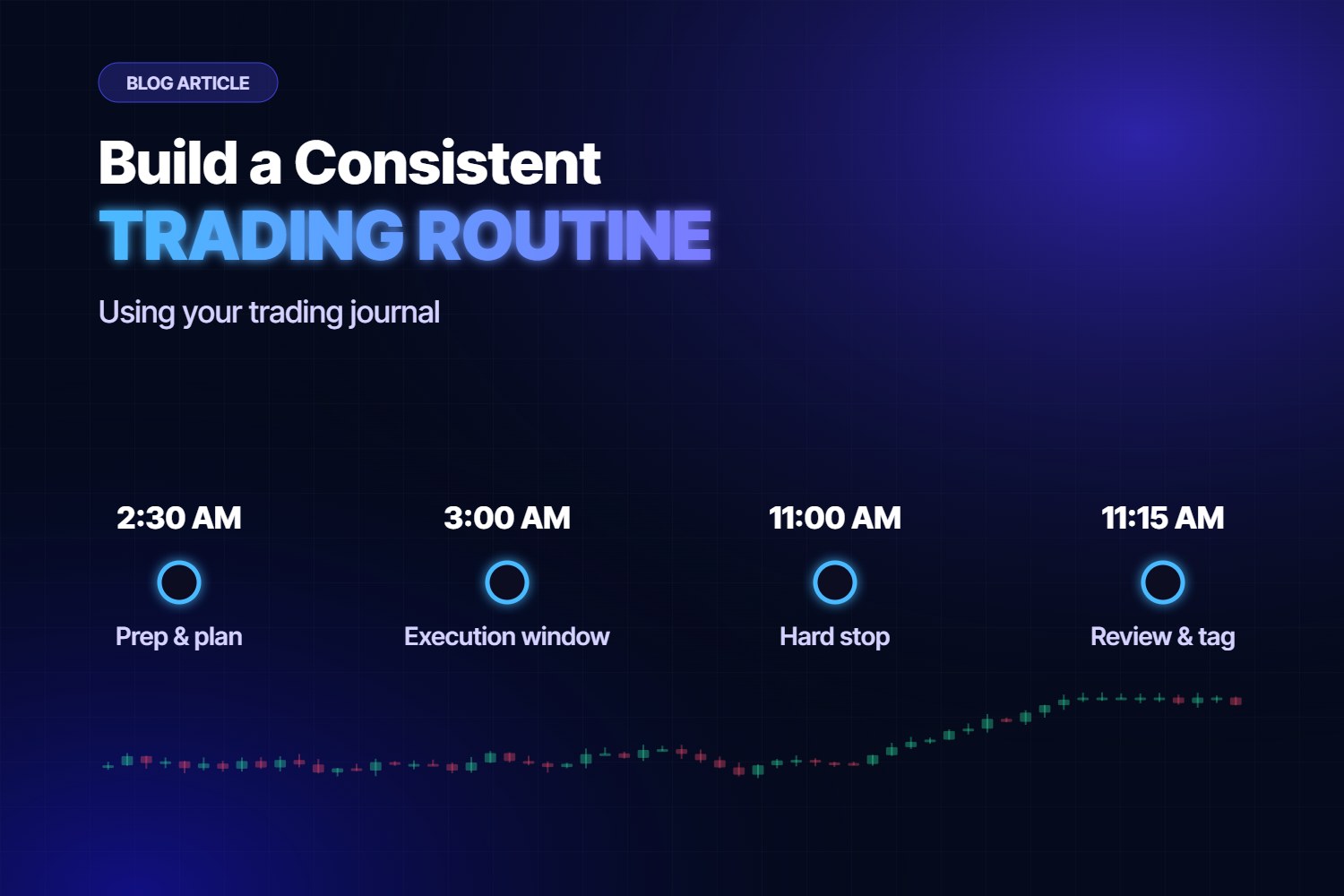
- 2:30 AM EST — Personal check-in, economic calendar, mark levels
- 2:50 AM — Write today's plan in the journal
- 3:00 – 11:00 AM — Execution window (max 3 trades, stop after 2 losses)
- 11:00 AM — Hard stop. Close the platform.
- 11:15 AM — Post-session review and trade tagging
Your times will differ. What matters is that they're fixed, written, and followed.
Use Your Journal to Refine the Routine
Your routine shouldn't be static.
Track it like a strategy:
- Compare results on days you followed your routine vs. days you didn't
- Test small changes one at a time (e.g. a shorter trading window)
- Keep what improves results. Drop what doesn't.
Many traders find that simply following their routine — without changing their strategy at all — is the biggest improvement they ever make.
Common Routine Mistakes
- Making it too complex to follow every day
- Skipping prep when the market “looks exciting”
- Trading past your stop time
- Skipping post-session reviews after losing days
- Never reviewing whether the routine itself is working
How Clarity Tracking Supports Your Routine
Clarity Tracking makes the journaling side of your routine fast and consistent.
- Trades imported automatically after each session
- Quick tagging for strategy, session, and emotions
- Rule compliance tracked on every trade
- Performance breakdowns by time and session
- Clear metrics for weekly and monthly reviews
When journaling takes minutes, your routine is far easier to keep.
Final Thoughts
Consistency isn't a personality trait.
It's a schedule.
Prepare before you trade.
Trade only in your window.
Review after every session.
Refine every week.
Build the routine.
Let the journal prove it works.
Frequently Asked Questions
What should a trading routine include?
Four parts: pre-market preparation, a fixed execution window with clear stop rules, a short post-session review, and weekly and monthly reviews of your journal.
How long should pre-market preparation take?
Usually 15 to 30 minutes: a quick personal check-in, the economic calendar, key levels, and a written plan for which setups you'll trade and when you'll stop.
How do I know if my trading routine is working?
Compare your results on days you followed the routine with days you didn't. If the routine days show better rule compliance and expectancy, it's working.
Related Articles
Take Control of Your Trading Performance
Stop guessing. Start knowing. Track every trade, understand your numbers, and build real consistency with Clarity Tracking.


