


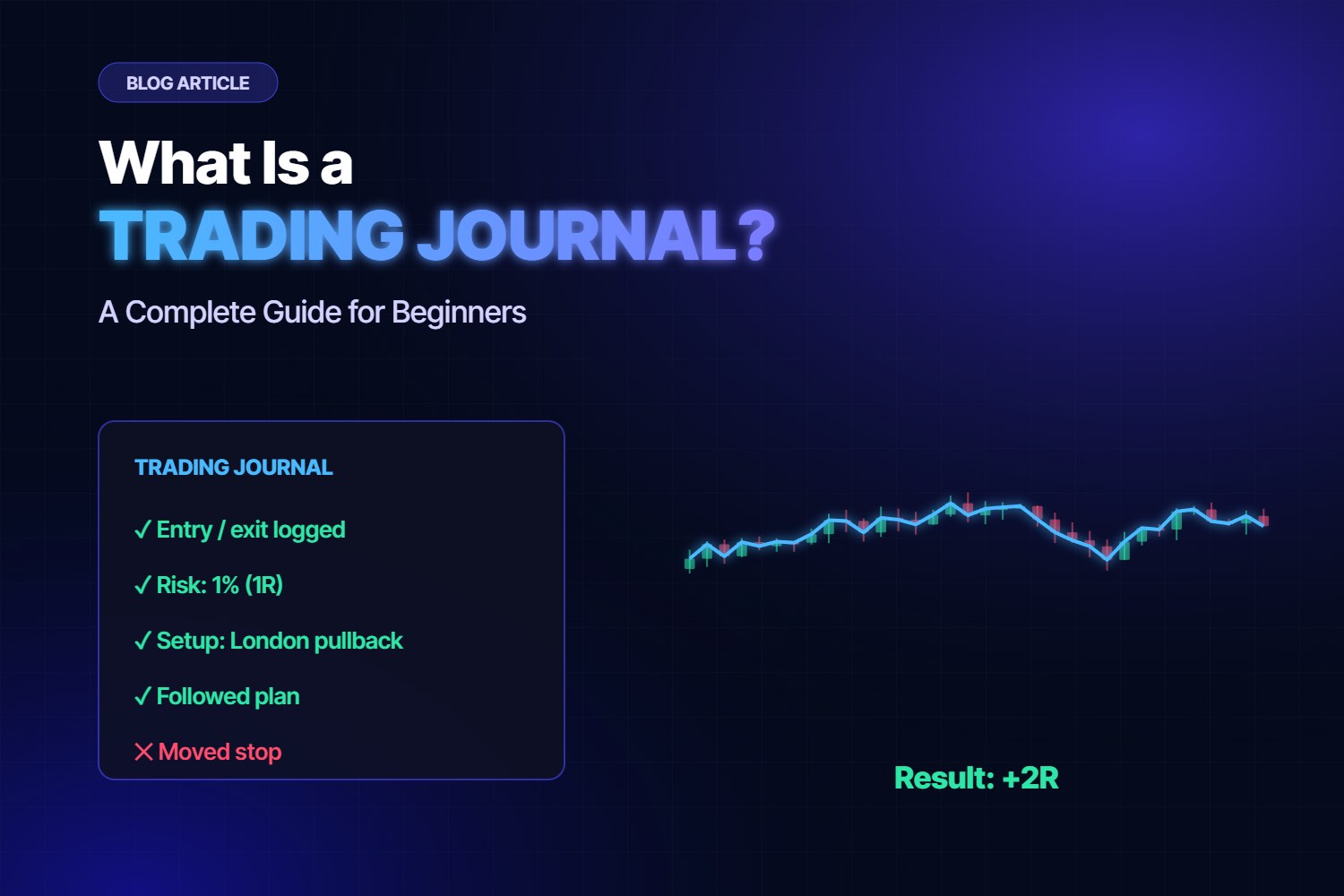
What Is a Trading Journal? A Complete Guide for Beginners
Every trader keeps a record of their results.
Your broker does it for you. It's called a statement.
But a statement only tells you what happened. It never tells you why.
That's the job of a trading journal.
If you're new to trading, starting a journal is the single highest-leverage habit you can build. This guide explains what a trading journal is, what to put in it, and how to use it so it actually improves your results.
What Is a Trading Journal?
A trading journal is a structured record of every trade you take — plus the context around it.
It captures:
- The numbers (entry, exit, size, result)
- The reasoning (why you took the trade)
- The conditions (market, session, volatility)
- The behavior (how you felt and whether you followed your rules)
Over time, those records become a dataset.
And a dataset can answer questions your memory can't.
Why Beginners Need a Journal More Than Anyone
Experienced traders journal to refine an edge.
Beginners journal to find out whether they have one at all.
In your first months, you'll try different setups, markets, and timeframes. Without a record, it all blurs together. You'll remember the big win and forget the five small losses that came before it.
A journal protects you from three beginner traps:
- Memory bias — remembering wins more vividly than losses
- Strategy hopping — abandoning an approach before you have enough data to judge it
- Repeating mistakes — making the same error for months because no one wrote it down
You can't fix a pattern you can't see.
What to Record for Every Trade
Start simple. You can add detail later.
The Essentials
- Date and time
- Market / instrument
- Direction (long or short)
- Entry price and exit price
- Stop loss and target
- Position size and risk (in $ and %)
- Result (in $ and in R)
The Context
- Strategy or setup name
- Session (Asia, London, New York)
- Market condition (trending, ranging, news-driven)
- A screenshot of the chart at entry
The Behavior
- Did you follow your plan? (Yes / No)
- Emotional state before the trade
- One sentence on what you'd do differently
That last field is where most of the learning happens.
What Is “R” and Why Should You Use It?
R is your initial risk on a trade.
If you risk $100 and make $250, that's a +2.5R trade.
If you risk $100 and lose $100, that's a −1R trade.
Measuring in R lets you compare trades fairly, even when your account size or position size changes. It's the language professional traders use to talk about performance.
A Simple Example Journal Entry
- Date: Tuesday, 9:42 AM EST
- Market: EUR/USD
- Setup: London trend pullback
- Entry / Stop / Target: 1.0850 / 1.0830 / 1.0890
- Risk: 1% ($100)
- Result: +2R ($200)
- Followed plan: Yes
- Emotion: Calm, slightly impatient waiting for entry
- Lesson: Waiting for the candle close gave a better entry than jumping in early.
It takes two minutes. It pays off for years.
How to Actually Use Your Journal
Logging trades is only half the job.
The value comes from reviewing them.
Daily (5 minutes)
Complete every entry while it's fresh. Add your notes and screenshots.
Weekly (30 minutes)
Ask:
- Did I follow my rules?
- What was my best trade, and why?
- What was my worst trade, and was it a good loss or a bad one?
- What's one thing I'll do differently next week?
Monthly (1 hour)
Look at the numbers: win rate, average win vs. average loss, expectancy, and drawdown. Compare setups and sessions against each other.
Good Losses vs. Bad Losses
This is one of the most important ideas a journal teaches.
A good loss is a trade that followed your plan and simply didn't work. Losses like this are a cost of doing business.
A bad loss is a trade where you broke a rule — moved a stop, oversized, chased an entry.
Your journal separates the two. Beginners who learn this early stop beating themselves up over good losses and start eliminating bad ones.
Paper, Spreadsheet, or Dedicated Journal?
Any journal is better than none.
- Paper notebooks are great for reflection but impossible to analyze at scale.
- Spreadsheets are flexible but require manual entry and formula maintenance (see the full comparison).
- Dedicated trading journals import trades automatically and calculate metrics for you.
The best journal is the one you'll use consistently. For most traders, that means reducing friction as much as possible.
How Clarity Tracking Makes Journaling Easy
Clarity Tracking is built to remove the busywork from journaling so you can focus on learning.
It helps you:
- Automatically import and log your trades
- Tag trades by strategy, session, and market
- Calculate win rate, expectancy, and drawdown for you
- Track rule compliance and emotional patterns
- See your performance on clear dashboards
Less time typing. More time improving.
Final Thoughts
A trading journal isn't a diary.
It's a mirror.
It shows you exactly how you trade — not how you think you trade.
Start today:
- Log every trade
- Measure in R
- Note your behavior
- Review every week
The traders who improve fastest aren't the most talented.
They're the ones who write it down.
Frequently Asked Questions
What should a beginner track in a trading journal?
Start with the essentials: date, market, direction, entry, exit, stop loss, position size, result in dollars and in R, the setup you traded, the session, and whether you followed your plan. Add emotions and screenshots once logging the basics is a habit.
How often should I review my trading journal?
Complete each entry the same day, review your trades and rule compliance weekly, and review metrics like win rate, expectancy and drawdown once a month.
Is a spreadsheet good enough as a trading journal?
If you take only a few trades a week, a spreadsheet works well. As your trade count grows, manual entry and formula upkeep often become the reason traders stop journaling, which is where a dedicated journal helps.
Related Articles
Take Control of Your Trading Performance
Stop guessing. Start knowing. Track every trade, understand your numbers, and build real consistency with Clarity Tracking.


