


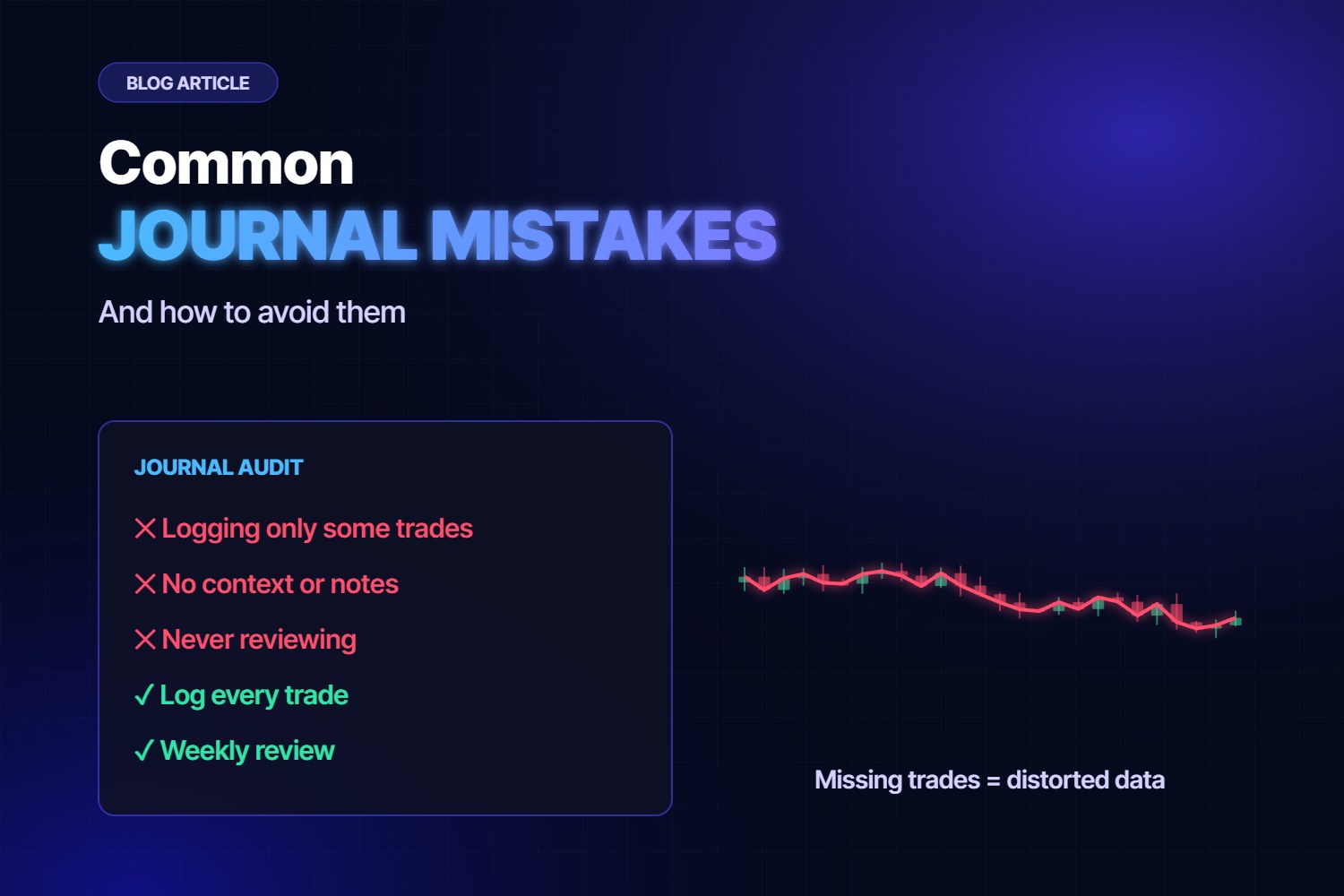
Common Trading Journal Mistakes and How to Avoid Them
Starting a trading journal is easy.
Getting real value from it is harder.
Many traders journal for months and see little improvement. Not because journaling doesn't work — but because they're making mistakes that quietly make their data useless.
Here are the most common trading journal mistakes, and how to fix each one.
Mistake #1: Only Logging Some Trades
The most damaging mistake of all.
Traders skip the embarrassing trades — the revenge trade, the oversized loss, the impulsive entry.
But those are exactly the trades that matter most.
A journal missing your worst trades will always make you look better than you are.
The fix: Log every trade, every time. Better yet, use automatic import so skipping isn't even possible.
Mistake #2: Recording Numbers but No Context
Entry, exit, P&L — and nothing else.
That's a broker statement, not a journal.
Without context, you can't learn why a trade won or lost.
The fix: For every trade, capture at least:
- Strategy / setup name
- Session
- Whether you followed your rules
- One sentence on your reasoning or emotional state
Mistake #3: Logging but Never Reviewing
Many traders are diligent about entering trades — and then never look at them again.
A journal you don't review is just storage.
The fix: Schedule reviews like appointments, as part of your trading routine:
- Weekly: 30 minutes reviewing trades and rule compliance
- Monthly: 60 minutes reviewing metrics and strategy performance
Mistake #4: Inconsistent Tags and Categories
One week it's “breakout.” The next it's “BO.” Then “break out.”
Inconsistent tags split your data into fragments that can't be compared.
The fix: Create a fixed list of strategy names, sessions, and emotion tags. Use only those. Review and clean up your tag list once a month.
Mistake #5: Tracking Too Much
Some traders build journals with 40 fields per trade.
It lasts about two weeks.
When journaling feels like homework, consistency collapses.
The fix: Start with the essentials. Add a new field only when you have a specific question you want it to answer.
Mistake #6: Judging Results From Tiny Samples
“This strategy lost 4 trades in a row. I'm dropping it.”
Four trades is noise, not a verdict.
The fix: Wait for at least 30–50 trades before drawing conclusions about a strategy, and 100+ before major changes.
Mistake #7: Focusing Only on P&L
Profit and loss is the most emotional number in your journal — and often the least informative over short periods.
A good trade can lose. A bad trade can win.
The fix: Grade trades on process, not outcome. Track rule compliance alongside P&L, and focus on expectancy over time.
Mistake #8: Not Measuring in R
A $500 loss means very different things on a $5,000 account vs. a $100,000 account.
Dollar figures make trades hard to compare as size changes.
The fix: Record every result in R (multiples of your initial risk) as well as dollars. Here's how R, win rate and expectancy fit together.
Mistake #9: Skipping the Emotional Side
Many traders feel uncomfortable writing down that they were angry, bored, or desperate.
But emotional state is often the strongest predictor of a bad trade.
The fix: Add a simple emotion tag before each trade. Be honest — no one else needs to see it. See how to track trading psychology.
Mistake #10: No Action After the Review
You review. You notice a pattern. You nod.
And next week you do the same thing.
The fix: End every review with one specific, written action:
- “No trades after 12 PM EST this week.”
- “Maximum two losses per day.”
- “Only A+ setups on gold.”
Then check whether you followed it at the next review.
Mistake #11: Overreacting to Single Trades
One large loss leads to a complete strategy overhaul.
That's emotional journaling, not analytical journaling.
The fix: Ask whether the loss followed your rules. If it did, it was a cost of doing business. If it didn't, the fix is discipline — not a new strategy.
Mistake #12: Relying on Manual Entry Forever
Manual journaling is fine at first. But as trade volume grows, it becomes the reason journaling stops.
The fix: Automate the data collection so your energy goes into the review, not the typing (here's how journals compare to spreadsheets).
How Clarity Tracking Helps You Avoid These Mistakes
Clarity Tracking is designed to remove the friction that causes most journaling failures.
- Trades are imported automatically — nothing gets skipped
- Consistent tags for strategy, session, and market
- Results calculated in R and dollars
- Rule compliance and emotional tracking built in
- Clear metrics that make reviews quick and focused
Less admin. More insight.
Final Thoughts
A trading journal is only as good as the habits behind it.
Log everything.
Keep it simple.
Tag consistently.
Review on schedule.
Act on what you find.
Avoid these mistakes, and your journal stops being a record of the past.
It becomes a plan for the future.
Frequently Asked Questions
What is the biggest trading journal mistake?
Only logging some trades. Skipping the impulsive or embarrassing trades removes exactly the data you need and makes your results look better than they are.
How long should trading journaling take?
About one to two minutes per trade, plus a 30-minute weekly review and an hour each month. If it takes much longer, you are probably tracking too many fields.
What should I do after reviewing my trading journal?
Write down one specific action for the next week, such as a time cutoff or a daily loss limit, and check at your next review whether you followed it.
Related Articles
Take Control of Your Trading Performance
Stop guessing. Start knowing. Track every trade, understand your numbers, and build real consistency with Clarity Tracking.


